
Last Updated: August 4, 2026
Author: Myung Joong Kim, CEO, Fresnel Factory Inc.
Reading Time: Approximately 6 minutes
Quick Answer
This project uses two PIR sensors that monitor different areas at different target distances.
A single Fresnel lens must therefore contain separate optical regions aligned with the two sensors.
- Each lens segment can be assigned to one of the two PIR sensors.
- Segments can be optimized for different target directions and detection distances.
- The optical energy distribution of individual segments can be adjusted to balance detection sensitivity.
- Cylindrical and spherical Fresnel structures can be combined in one injection-molded lens.
- The final lens geometry must be reviewed for optical performance, sensor alignment, mold fabrication, and injection feasibility.
What Was the Optical Requirement for This Two-Sensor PIR System?
The customer’s preliminary concept used two PIR sensors in one detection system.
The sensors were not intended to monitor the same area or the same distance.
Instead, the system required:
- One PIR sensor to monitor one specified region.
- A second PIR sensor to monitor a different region.
- Different target distances for the two monitored regions.
- Separate Fresnel lens segments assigned to each sensor.
- Balanced sensitivity among the detection zones assigned to each sensor.
The lens surface therefore had to be divided into separate optical regions.
One group of lens segments directs infrared energy from its assigned monitoring area toward the first PIR sensor,
while another group directs energy from a different area toward the second PIR sensor.
Because the two sensors monitor different distances and regions, the lens segments do not necessarily have
the same focal direction, optical power, aperture, or zone geometry.
How Is a Two-Sensor Fresnel Lens Different from a Conventional PIR Lens?
A conventional PIR Fresnel lens often uses a repeated arrangement of lens segments around one sensor.
Each segment creates a detection zone at a different angle, and the sensor detects changes in infrared energy
as a person or object moves between those zones.
In a two-sensor system, however, the optical layout must account for two separate sensor positions.
Each segment must be designed not only for its target direction but also for the PIR sensor to which it is assigned.
| Design factor | Conventional single-sensor lens | Two-sensor multi-zone lens |
|---|---|---|
| Number of PIR sensors | Typically one | Two |
| Monitored areas | One combined coverage area | Two separately defined regions |
| Target distances | Usually based on one primary range requirement | Different distances for each sensor region |
| Segment assignment | All segments direct energy to one sensor | Different segment groups are assigned to different sensors |
| Optical structure | Often based on one primary segment type | May combine spherical and cylindrical structures |
Can Each Fresnel Lens Segment Have a Different Optical Energy Distribution?
Yes. Each Fresnel lens segment can be designed and optimized independently according to its assigned function.
Important segment-level design variables include:
- The PIR sensor assigned to the segment
- Target direction
- Target distance
- Horizontal and vertical detection angle
- Required detection-zone width
- Segment aperture
- Overlap with adjacent zones
- PIR sensor active-area dimensions
- Lens-to-sensor distance
- Required signal level
A segment intended for a long-distance monitoring area may require a different aperture, focal direction,
and optical energy level from a segment designed for a closer or wider region.
A multi-zone Fresnel lens is therefore not necessarily designed by repeating identical lens segments.
Each segment can be optimized for its target direction, distance, required sensitivity, assigned PIR sensor,
and manufacturing constraints.
Does Uniform Sensitivity Require Equal Optical Energy from Every Segment?
Not necessarily. Uniform detection performance does not always mean that every lens segment must produce
an identical optical-energy peak.
In this project, the two PIR sensors monitor different areas and different target distances.
The energy requirements of the segments assigned to the first sensor may therefore differ from those
assigned to the second sensor.
Several factors influence the signal generated by each lens segment:
- Target distance
- Target angle
- Segment aperture
- Sensor sensitivity
- Sensor active-area geometry
- Target movement direction
- Optical losses
- Lens-to-sensor distance
- Mechanical alignment
For this reason, producing equal energy at every target position does not necessarily result in equal sensor output.
A more practical objective is to adjust the segment energy distribution so that each PIR sensor achieves
the required response throughout its assigned monitoring area.
What Does the 30 m Optical Simulation Show?
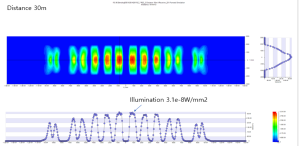
The simulation above represents one of the two sensor channels.
It evaluates the optical-energy distribution on a target plane located 30 m from the lens.
The second PIR sensor is intended to monitor another area at a different target distance.
The colored regions show the energy distribution generated by the individual Fresnel lens segments.
The lower graph shows the corresponding energy profile across the target plane.
A reference value of approximately 3.1 × 10⁻⁸ W/mm² is shown in the simulation.
This value is a result obtained under the specific simulation conditions and should not be interpreted
as a general product specification or guaranteed detector performance.
During optical optimization, individual segments can be adjusted to modify:
- Peak energy
- Detection-zone position
- Zone width
- Spacing between zones
- Overlap between adjacent zones
- Center-zone and edge-zone response
Can Cylindrical and Spherical Structures Be Combined in One Fresnel Lens?
Yes. Cylindrical and spherical optical structures can be incorporated into a single injection-molded Fresnel lens.
| Optical structure | Typical function |
|---|---|
| Spherical lens segment | Focuses infrared energy in two axes to form a relatively concentrated detection zone. |
| Cylindrical lens segment | Focuses energy primarily in one axis and creates an elongated detection zone in the other axis. |
| Hybrid lens structure | Combines different zone shapes for separate PIR sensors, target distances, or monitoring regions. |
In a two-sensor PIR system, one part of the lens may need concentrated zones for a specific long-distance area,
while another part may require wider or elongated zones for another monitoring region.
Integrating cylindrical and spherical structures in one lens makes it possible to implement these different
optical functions within a single molded component.
The final structure depends on:
- The positions of the two PIR sensors
- The monitoring-area geometry assigned to each sensor
- The target distance for each region
- The required horizontal and vertical field of view
- The available lens dimensions
- The mechanical enclosure design
What DFM Factors Affect a Hybrid Fresnel Lens?
A lens geometry that performs well in optical simulation must also be suitable for mold fabrication
and injection molding.
A Design for Manufacturing review normally considers:
- Minimum groove pitch
- Groove depth
- Minimum optical feature size
- Local lens thickness
- Draft angle
- Sharp optical features
- Mold-machining accessibility
- Injection gate position
- Resin flow and filling balance
- Demolding direction
- Dimensional tolerance
- Warpage risk
When a geometry change is required from a DFM perspective, the expected optical effect should be reviewed
with the customer before mold fabrication begins.
Reviewing optical performance and manufacturability together reduces the risk of changing critical optical
surfaces after tooling has already started.
What Information Is Required to Design a Fresnel Lens for Two PIR Sensors?
| Required information | Why it is required |
|---|---|
| PIR sensor models | Confirms the sensor structures and operating characteristics. |
| Sensor active-area dimensions | Determines focal geometry and segment dimensions. |
| Position and orientation of both sensors | Defines the optical regions assigned to each PIR sensor. |
| Lens-to-sensor distances | Determines the focal geometry and achievable field of view. |
| Target distance for each sensor | Determines the optical requirements for the two monitoring regions. |
| Monitoring-area drawings | Defines the required detection-zone positions and coverage. |
| Horizontal and vertical field of view | Defines the overall lens coverage. |
| Available lens dimensions | Defines the usable optical area. |
| Lens material and environmental requirements | Affects infrared transmission, durability, and manufacturing. |
| Expected annual usage | Supports tooling, quotation, and production planning. |
All dimensions and units in the customer’s drawings should be confirmed before optical design begins.
For example, a target-distance value shown as “30” may refer to 30 m, not 30 mm.
How Can Fresnel Factory Support a Two-Sensor PIR Lens Project?
Fresnel Factory supports custom Fresnel lens development for PIR sensing systems, including:
- Two-sensor and multi-sensor optical layouts
- Detection-zone design
- Segment-level energy optimization
- Cylindrical and spherical lens integration
- Optical simulation
- DFM review
- Mold fabrication
- Injection molding and sample production
Request a Custom Optical Design Review
To discuss sensor positions, target distances, detection zones, or a hybrid cylindrical and spherical
Fresnel lens structure, visit our optical design service page.
Optical Design, Lens Simulation, and System Design Consultancy
After injection-molded samples have been produced, Fresnel Factory can also support detector-level
performance evaluation.
Learn more about
optical performance testing for infrared sensing devices
.
Frequently Asked Questions
Can one Fresnel lens be used with two PIR sensors?
Yes. Separate regions of one Fresnel lens can be designed to direct infrared energy toward two different PIR sensors.
Can two PIR sensors monitor different target distances?
Yes. The lens segments assigned to each sensor can have different focal directions, optical power,
apertures, and zone geometries according to the required distance.
Do all Fresnel lens segments need the same shape?
No. Individual segments can have different apertures, focal directions, optical energy levels,
and detection-zone shapes.
Can cylindrical and spherical Fresnel structures be injection molded together?
Yes, provided that the combined structure meets mold-machining, resin-flow, tolerance,
and demolding requirements.
Does equal optical energy guarantee equal PIR sensitivity?
No. PIR response also depends on target distance, target angle, sensor characteristics,
movement direction, optical loss, and mechanical alignment.
Can one part of the lens be designed for 30 m and another part for a shorter distance?
Yes. Separate groups of lens segments can be optimized for different target distances
and assigned to different PIR sensors.
Can the detection pattern be evaluated before mold fabrication?
Optical simulation can be used to review zone positions, energy distribution, target distances,
and expected coverage before tooling. Physical detector testing is still recommended after samples are produced.
What information is required for an optical design quotation?
The required information normally includes sensor models, sensor positions, active-area dimensions,
lens-to-sensor distances, target distances, detection-zone drawings, available lens dimensions,
environmental requirements, and expected annual usage.